
Multifamily building performance
Multifamily Rebates and Incentives in Illinois
- Property first
- Human review
- Clear next step
Illinois utility programs fund energy work in multifamily buildings, and for qualifying properties they can cover a meaningful share of a project. The catch is that the paperwork is front-loaded: most of it has to be filed and approved before the first crew shows up. This page covers how multifamily rebates and incentives in Illinois actually work, which program your address falls under, what each one funds, and the order the forms get filed in. Building Energy Experts is an authorized contractor for the ComEd, Nicor Gas, Peoples Gas and North Shore Gas efficiency programs, and we file the program paperwork ourselves, from pre-approval through final submission.
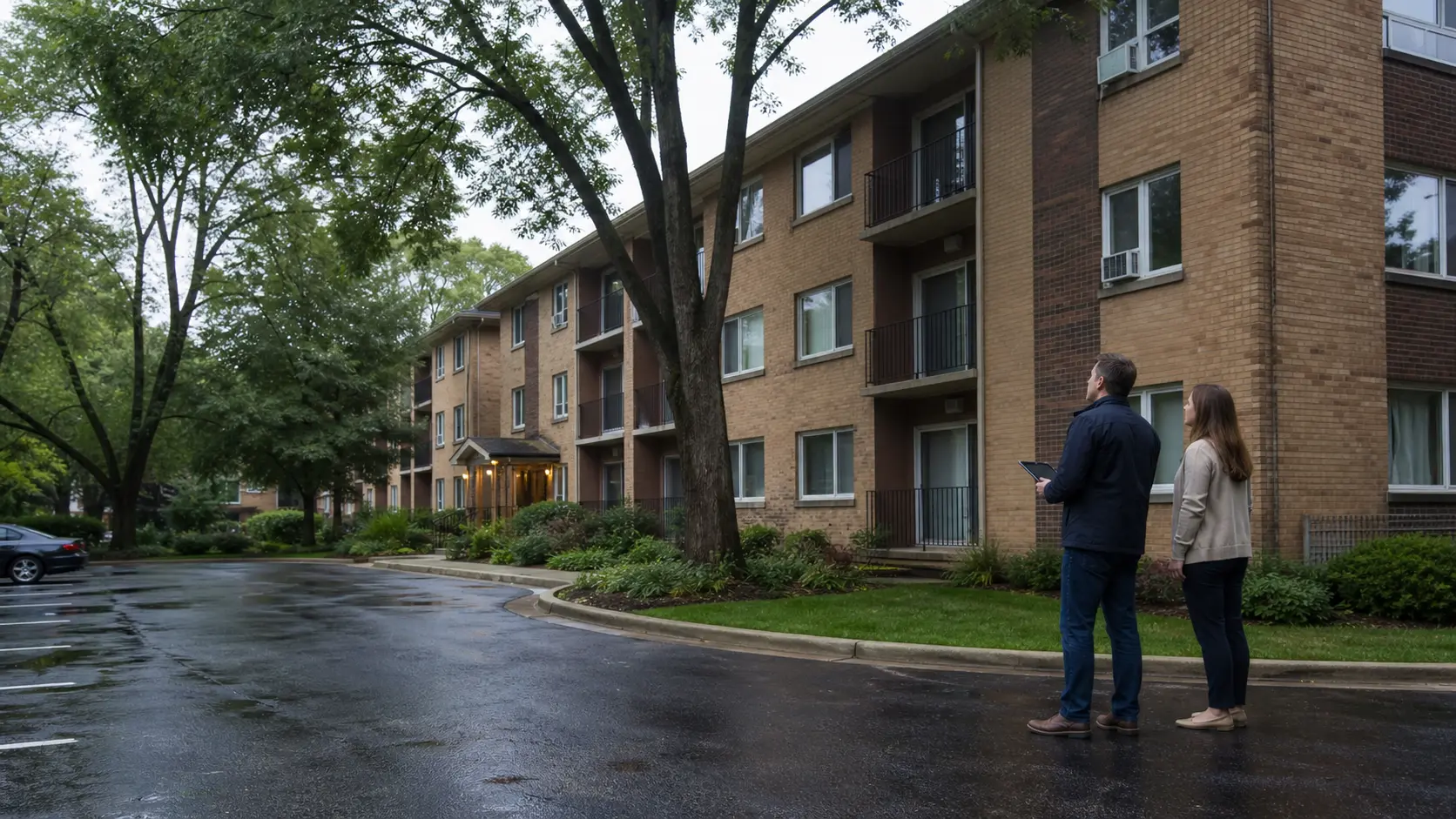
Your service territory decides the program, not your city
Program eligibility follows the utility that serves the meters, not the municipality on the mailing address. Peoples Gas serves the City of Chicago. North Shore Gas serves communities along the north lakefront, including Evanston, Wilmette and Highland Park. Nicor Gas covers much of the rest of northern Illinois. A building can sit on Nicor Gas for heat and ComEd for electricity while a property a few miles away is on a different gas program entirely.
The gas and electric maps do not line up with each other or with village boundaries, so two buildings on the same street can fall under different programs. That is why the review starts with the address and the utility accounts, not a ZIP code lookup. No web page can state final eligibility, and a ZIP result never is one. Here is what a property-specific review establishes.
- The gas utility serving the building: Nicor Gas, Peoples Gas, or North Shore Gas
- The electric utility serving the units and the common areas
- Unit count. Our work starts at 3 units.
- Whether the property is being reviewed on a market-rate path or an income-eligible path
- Whether the improvement is on that program's current list of funded measures
What multifamily rebates and incentives in Illinois actually cover
Gas programs and the electric program fund different measures, and that split drives most of what follows. The gas side funds the building envelope and gas equipment: insulation at the attic floor, exterior walls, rim joists and basement, plus air sealing, duct sealing, and high-efficiency furnaces, boilers and water heaters. The electric side funds common-area lighting retrofits, controls, motors, and electric equipment, subject to current program rules. Because they fund different measures, one project can draw on a gas program and an electric program at the same time. We coordinate them so the building is documented once and submitted under each program's own rules.
In its published multifamily weatherization materials, Nicor Gas sets incentive rates by measure rather than as one lump sum. Duct sealing is paid per furnace, air sealing per linear foot of gap sealed, door sweeps per door, and attic insulation per square foot at a tiered rate that depends on how much insulation is already up there. That structure changes what is worth doing first, because a nearly bare attic earns at a different rate than a partially insulated one. Rates are set by the utility and change between program years, so we confirm the current published schedule at pre-approval rather than quote a figure that may be stale.
For income-eligible properties in the Nicor Gas territory, the weatherization path may cover the full project cost, depending on the program and the address. Income eligibility there is generally assessed on tenant income rather than owner income, so an owner who assumes the building is market-rate can still be wrong about which path applies.
Pre-approval comes before the work, not after
The most common way we see a multifamily incentive lost is sequence. These programs are built around pre-approval: the scope is submitted and reviewed before any material goes into the building. Work that is already finished usually cannot be funded after the fact, because there is no way left to verify the pre-existing condition. If your maintenance crew insulated the attic last spring, that work is generally not recoverable.
Deadlines are the second way it goes wrong. Program years open and close, and an approval can carry an expiration date. We track those against your construction schedule so the approval and the crew land in the same window. The order below is the order the file gets built in.
- Assessment and documentation of existing conditions, with diagnostic testing when appropriate and required
- Scope and pre-approval package submitted to the applicable program. Work does not start until the program's written approval comes back.
- Pre-installation inspection where the program requires one
- Installation, with material type, depth or coverage, and quantities documented as the crew works
- Post-installation verification required by the approved measure and program
- Final submission of the complete evidence package, then follow-up until the program closes the file
The paperwork. We file it.
Plenty of contractors hand the program forms back to the owner and call that a rebate service. We prepare and submit them in house, as the participating contractor on the file. Here is the split.
Our side: confirm which programs apply to the address, submit the pre-approval package, assemble the pre-installation documentation, schedule and meet the inspections, keep the mid-project records, run the post-installation testing, submit the final package, and follow up until the program closes the file.
Your side: basic building information and unit count, the gas and electric account numbers, written authorization for us to act on the property's behalf with the utility, signatures on the participation forms we prepare, tenant access windows for the units we need to enter, and approval of the scope and timeline. Then you receive the work, the written report, and whatever the program pays out under the structure that applies to your project, if the submission is approved.
Access is the part property managers underestimate. Programs commonly require entry to a sample of units for verification, and how many varies by program and building size. We give you the unit list and the dates well ahead of time, so notices go out on your normal schedule and under your own lease terms.
The measurement that proves the work is the same one that supports the file
Utility programs require evidence that varies by measure and program. The file can include the existing conditions, approved scope, installed quantities, photographs, invoices, inspection records, and diagnostic results when testing is required.
When comparable pre-work and post-work testing is part of the approved scope, those results support the submission. Other measures rely on different documentation. You receive the applicable closeout records in a form that can be shared with a board, lender, or future property manager.
When chasing an incentive is the wrong move
An incentive is a discount on work that is worth doing. It is not a reason to do work the building does not need, and we will say so. Cases where program money should not drive the decision:
- If the roof leaks or a wall assembly is holding moisture, insulating over it traps the problem. The water gets fixed first, by someone, before we insulate.
- If a boiler or furnace still has usable life and is running well, replacing it to capture an incentive can be a poor capital decision on its own terms.
- If the improvement your building needs is not on a program's current funded list, judge the work on comfort and operating cost alone.
- If the property has fewer than 3 units, we are not the right contractor for it.
- If open combustion appliances, ventilation problems, or moisture issues turn up, health and safety work usually has to come first, and that changes both the scope and the schedule.
- If the real complaint is a distribution or control problem rather than an envelope problem, insulation will not fix it, and no incentive makes the wrong measure right.
Common questions
Can we get an incentive for work we already completed?
Generally no. Illinois utility programs require pre-approval before installation, because the program has to verify the pre-existing condition. Once insulation is in the attic, there is no way to document what was there before. If a project is already underway, call before the next phase starts so the remaining scope can still be reviewed.
Do we pay for the work upfront and wait for a rebate?
It depends on the program path and the measures involved. Some incentives are paid to the contractor and applied against the project cost, and some are paid to the property owner after final submission. We tell you which structure applies to your project before you approve the scope, so you know what the out-of-pocket exposure looks like going in and what would change it.
Can one project draw on more than one program?
In many cases, yes. Gas and electric programs are separate and fund different measures, so envelope work can go to the gas program while common-area lighting or controls go to the electric program. Whether it works for a specific building depends on the service territories, the measures in scope, and the current program rules, which is why it takes a property-specific review.
What do I actually have to sign?
A participation form for each applicable program, and an authorization letting us act on the property's behalf with the utility. We prepare both. You also approve the final scope and timeline before any work starts.
Does my ZIP code tell me whether the building qualifies?
No. A ZIP code can narrow down the likely utility territory, but it does not decide eligibility. The utility account on the meter, the unit count, the building type, and current program requirements do. A ZIP result is never final eligibility.
What happens if required verification identifies a problem?
The issue is documented and the next step is coordinated according to the approved scope and program requirements. Building Energy Experts remains responsible for organizing the applicable closeout documentation, including work performed by qualified trade partners.
Next step
See what may apply to your building
A property-specific review is the only way to know which programs fit your address.