
Multifamily building performance
Duct Testing and Sealing for Multifamily Buildings
- Property first
- Human review
- Clear next step
Leaky ducts in a multifamily building can lose conditioned air before it reaches the intended space. Duct testing and sealing may be included when appropriate for the system, access conditions, approved scope, and program requirements. When comparable pre-work and post-work pressure testing is required and performed, the results can document the change. Eligibility and documentation requirements are settled by a property-specific review, not by a web page.
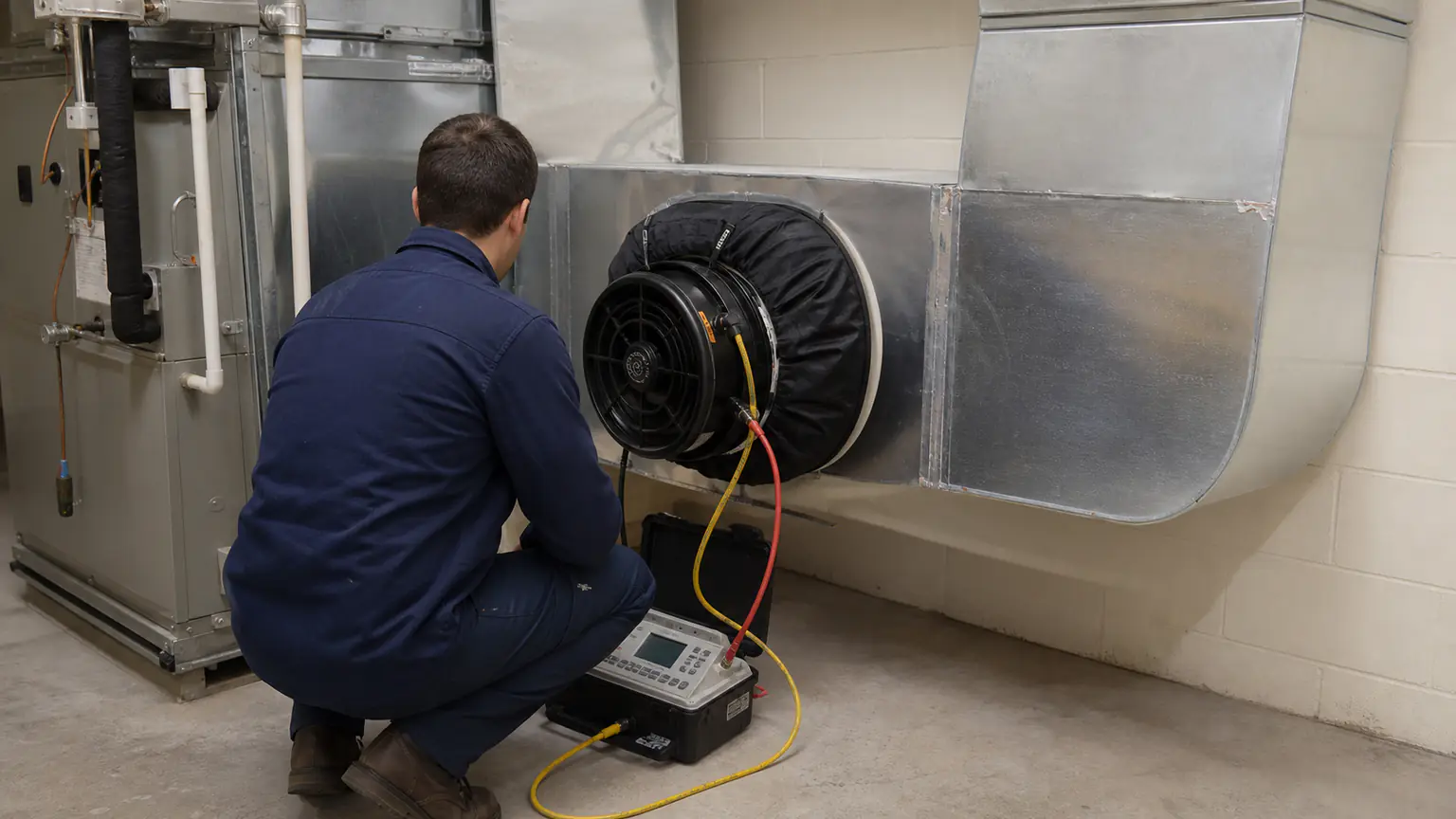
What a duct pressure test actually measures
When duct pressure testing is included, the test setup and method depend on the system, building, access, safety conditions, and applicable program requirements. A calibrated fan can be used to pressurize ductwork and report leakage in CFM25. The project record should state the method actually used rather than imply that every system received the same test.
Some scopes consider total duct leakage, while others need leakage-to-outside information or different verification. The approved scope identifies which result is required and whether comparable pre-work and post-work readings apply.
Where the leakage usually is in an older Chicagoland building
The loss in a mid-century Chicagoland building usually sits in a short list of predictable places, none of them visible from the register grille. The test says how much is escaping. The walkthrough says where.
- Supply takeoffs and boots that were tape-only from the start and have since pulled away from the trunk
- Panned joist returns and other building-cavity returns drawing air from the basement, crawl space, or attached garage instead of from the unit
- Crushed, kinked, or torn flex duct above dropped ceilings and behind mechanical closet doors
- Open seams at the plenum, the filter slot, and the air handler cabinet itself
- Register boots sitting loose against the subfloor or drywall with a gap around the whole perimeter
- Cloth duct tape applied decades ago that dried out, lost adhesion, and let go of the joint
- Stripped or missing duct insulation on runs through vented attics and crawl spaces
- Disconnected sections and structural damage in spaces nobody has entered in years
How the sealing is done, and what never goes on your building
Mastic does the work: a brush-applied compound that stays flexible for decades, worked into every accessible joint, seam, and boot connection. Gaps wider than about a quarter inch get fiberglass mesh embedded in the mastic to bridge. Sections that have physically separated are mechanically fastened first, because sealant is not a structural fix. Foil-backed tape rated for duct use handles accessible seams where mastic is impractical. Standard cloth duct tape does not go on your building. It is the material that has already failed on the joints we get called in to fix.
Where a return was built out of a joist cavity or wall bay, the repair is usually sealed sheet metal, not caulk in a cavity never meant to carry air. Missing insulation on runs through unconditioned space is restored. Then the same test runs again, and the second CFM25 reading tells you whether the work landed.
Combustion safety is part of the test, not an extra
Tightening a return changes the pressure in the room the equipment sits in. Where an atmospheric furnace or water heater vents up a shared masonry chimney, that pressure is part of how the appliance drafts. Combustion safety testing is therefore part of the job, not an add-on. We check draft and spillage under worst-case conditions after sealing, and if an appliance cannot vent safely it goes in the report and to your contact before the system goes back in service.
What happens in occupied units
Duct work is a mechanical room job with a unit-access tail. We need the air handler closet plus every supply and return register on that system, which usually means entering each unit once. Registers are temporarily covered during the test. The system is off while it is being tested, so scheduling matters more in January and July than in April.
A building on one central system is often a test, seal, and retest sequence that fits inside a day, though the walkthrough sets the actual schedule. A building with a furnace per unit is scheduled system by system, so the day count tracks the number of systems and the pace of access. The mastic we use is water-based, with a mild odor while it cures, and it is applied in mechanical spaces, not living areas. Your property contact gets the unit list and the dates so notices go out on your letterhead.
What you receive, and what you have to supply
You receive the documentation required by the approved duct scope. That can include applicable pressure-test results, photographs of conditions found, notes on areas that could not be accessed or sealed, and safety records when required. We coordinate the applicable program paperwork from pre-approval through final submission.
Access needs depend on the system and testing method. The property contact receives the required mechanical-space or unit access, shutdown window, resident-notice needs, and utility information before work is scheduled.
When duct testing and sealing is the wrong answer for your building
Plenty of Chicagoland multifamily buildings have no ducts worth testing. Steam and hot water radiators, hydronic baseboard, through-wall PTAC units, electric resistance heat, and ductless mini-splits have no forced-air distribution, so there is nothing to pressurize and nothing to seal. If that is your building, the money belongs in the envelope and the mechanical plant.
Three other cases send us elsewhere. If the whole duct run sits inside the heated envelope, leakage still costs fan energy and unbalances rooms, but the assessment usually ranks attic and rim joist work ahead of it. If the ductwork is crushed, corroded, or disconnected across long runs, replacement is the honest call, not sealing. And if a pre-1980 system has suspect wrap or tape on the fittings, work stops: asbestos assessment and abatement are a separate licensed trade.
Common questions
Does my building even have ducts worth testing?
Only if it has forced-air distribution. Buildings heated by steam or hot water radiators, hydronic baseboard, through-wall PTAC units, electric resistance heat, or ductless mini-splits have no duct system to pressurize, so there is nothing for this measure to do. If your building has furnaces or air handlers pushing air through trunks and branches to registers, duct testing applies. The assessment confirms which system type you actually have before anything is scheduled.
What is CFM25, and what number should my building hit?
CFM25 is the cubic feet per minute of air measured during a duct pressure test at 25 pascals. There is no single passing number for every building. When comparable pre-work and post-work readings are required and collected, the project record can show the difference.
How much tenant access does duct sealing require?
Usually one visit per unit on the system being worked, because every supply and return register has to be blocked for the test and checked for leakage at the boot. The mechanical space carries most of the actual sealing work. Your property contact gets the unit list and the dates in advance, so resident notice goes out through your normal channel and in your format.
Is duct sealing covered by utility rebates?
Duct sealing may be an eligible measure for qualifying properties, depending on the program, address, system, and approved scope. Pre-approval and closeout requirements vary, and testing is included only when required and appropriate. We coordinate the applicable submission. What a specific property qualifies for comes out of a property-specific review, not a web page.
Should I do air sealing before duct sealing?
Often, but not always. Air sealing addresses leakage between the building and the outdoors. Duct sealing addresses leakage inside the delivery system. Where both are needed, they are typically bundled into one weatherization scope so the building is tested once, worked once, and documented once. The assessment ranks them for your building instead of assuming a fixed order.
What happens if you find asbestos on the ductwork?
Work stops on that system. Older systems can have suspect wrap or tape on fittings and trunks. Asbestos assessment and abatement are a separate licensed trade, and we do not disturb suspect material. You get a written note on what was observed and where, so you can bring in the right contractor before any sealing is scheduled.
Next step
See what may apply to your building
A property-specific review is the only way to know which programs fit your address.