
Who we serve
Comfort Upgrades for Income-Qualified Buildings in Northern Illinois
- Property first
- Human review
- Clear next step
Buildings where the top floor bakes in August and the ground floor runs space heaters in January. The work happens with residents at home, and what qualifies is the building and the address it sits at, not who owns it.
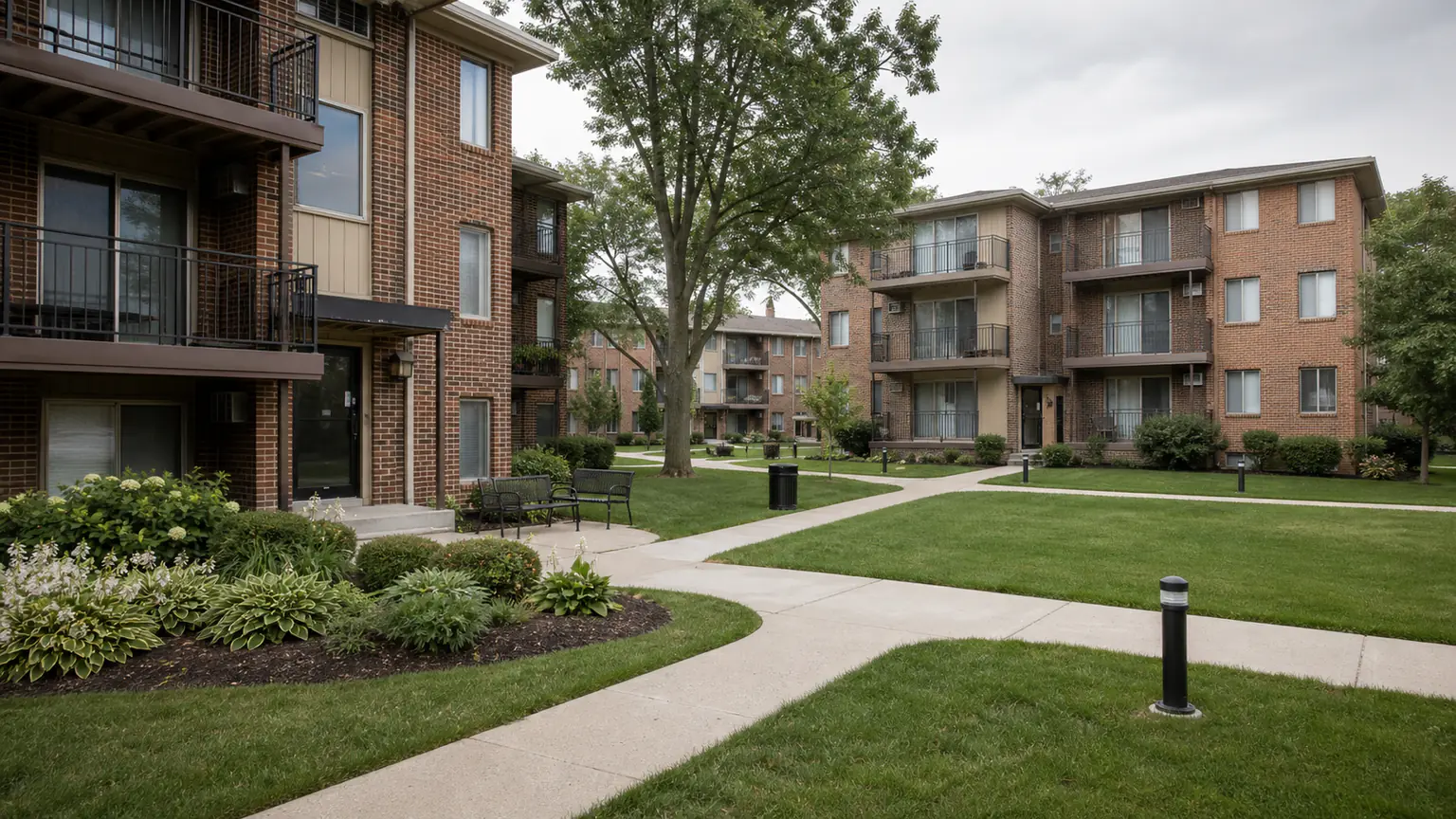
Start with the units nobody can keep comfortable
Every property has them. The top-floor apartment that stays hot into the night in August no matter where the thermostat sits. The corner unit with a draft nobody can find. The first-floor apartment where a resident runs a space heater from November to March. Your staff hears about those units every season, and the usual answers are a thermostat check, a filter change, and a service call on equipment that turns out to be working correctly.
Most of the time the equipment is not the problem. The building shell is. Air moves through the attic plane, the rim joist, and the open chases behind kitchens and bathrooms, and it carries conditioned air out with it. In summer, an under-insulated attic loads with heat all afternoon and pushes it into the units below well after sunset. Sealing and insulating that shell is what makes those apartments livable, and it happens to be the same work that lowers what the building burns.
- Top-floor units that hold heat overnight in summer, ground-floor units that never warm up in winter
- Drafts at baseboards, outlets, and unit entry doors that no thermostat setting fixes
- Space heaters and window units running because an apartment will not hold a temperature
- Stairwell and corridor doors that pull hard, which is the stack effect showing up where residents feel it
Residents stay home while the work happens
Nobody moves out. There is no staging, no storage pods, and no block of vacant units to hold open. Most of the scope lands in places residents never use anyway: the attic above the top floor, the rim joist in the basement, the chases, and the common stairwells. Where a crew does need to be inside an apartment, that visit is measured in hours rather than days.
Notice goes out on your normal schedule and under your own lease terms. You get the unit list and the dates far enough ahead that your office is not calling residents the night before. Crews work the daily unit count the property can actually absorb instead of the count that finishes fastest, floors get covered, and the space is left the way it was found. A missed appointment gets rescheduled rather than becoming a reason to skip the apartment, because an apartment skipped now is a comfort complaint that comes back next season.
- No relocation, no staging units, no resident storage
- Attic, rim joist, chase, and common-area work happens outside occupied apartments
- In-unit visits scheduled from a list you approve, with notice on your normal timeline
- Daily unit count set by what the property can absorb, not by how fast a crew can move
The building qualifies, not the owner
This is the part that gets properties written off. The review looks at the property: the address, the electric and gas service territory that serves it, the building itself, and how the space is used and metered. It does not start with your balance sheet, your tax status, or how long the asset has been held. A nonprofit, a family LLC, a housing authority, and a private portfolio all get the same review of the same building.
So a property somebody decided years ago was too expensive to upgrade is worth checking again. The ownership question was never the one that settled it. What settles it is the address and the program rules in force that year, and those rules move. If the property already carries a documented income restriction, the file you keep for that usually holds what the program asks for, which takes weeks off the front end.
No web page decides this, including this one. It takes a property-specific review of the address, the utility accounts, and the building.
- Building Energy Experts works on buildings with 3 or more units across northern Illinois
- The address and the utility service territory decide which program path applies
- Owner type, entity structure, and tax status are not what the review turns on
- For qualifying properties, envelope work may be available at no cost
Your residents already pay into this fund every month
Illinois utility efficiency programs are not a grant somebody discovered. They are funded through charges collected on gas and electric bills across the state. The residents in your building pay into that fund with every bill they pay. So does your office, and so does everyone else on the system.
That money is collected whether or not a dollar of it ever reaches your property. It reaches the buildings that apply. Every building on the system pays in, and only the ones that file get anything back, which means the properties that most need envelope work are frequently the ones quietly funding somebody else's. Filing is how the fund your residents are already feeding turns into insulation over their ceilings.
The paperwork is the part that stops people, so we handle it. Building Energy Experts is an authorized contractor for the ComEd, Nicor Gas, Peoples Gas, and North Shore Gas efficiency programs. Those programs generally require pre-approval before a crew starts, which means the order is application first and work second. We prepare and submit the pre-approval, keep the documentation the program requires while the project runs, meet the inspections, and file the final package.
What the assessment establishes
The assessment is a walk through your building, not a paperwork exercise. An analyst from Building Energy Experts reviews the envelope and the building systems, documents what is actually there rather than what the drawings say, and identifies the information the approved scope will need. Blower-door testing may be included when appropriate for the property and program.
Bring the comfort complaints to it. The units your staff hears about every season are evidence, and they usually point at something specific. The review separates likely envelope problems from distribution and equipment problems, so the building is not paying to insulate an attic when the real issue sits in the ductwork, or replacing equipment that was never the cause. You receive a written report that prioritizes practical next steps and identifies the program path that applies under current rules.
- Diagnostic test results when comparable testing is included in the approved scope
- Attic, wall, rim joist, and basement conditions documented at the unit and building scale
- Combustion appliance safety checked, since tightening a building changes how atmospherically vented equipment behaves
- Common areas, chases, and stairwells included, because that is where the stack effect does its damage
What changes for residents afterward
The measure of this work is not the report. It is whether the apartments hold a temperature.
Once the shell is sealed and insulated, the top floor stops taking the full load of the roof on an August afternoon, the drafts along baseboards and unit doors stop, and rooms that used to swing well past the setpoint stay closer to it. Air sealing also closes the paths that carry sound and cooking odors between units and in from the corridor, which is a complaint most properties stopped bothering to log. Residents who were running space heaters and window units to cover the gap generally stop needing them, and on a fixed income that shows up on a bill they pay themselves.
Tightening a building also changes how it breathes, so ventilation is planned alongside the sealing work rather than after it, and combustion appliances are checked, because atmospherically vented equipment behaves differently in a tighter building. That is not a footnote. It is the difference between a building that is comfortable and a building that is only tight.
Next step
See what may apply to this property
A property-specific review is the only way to know which programs fit your address and your building.